
Introduction
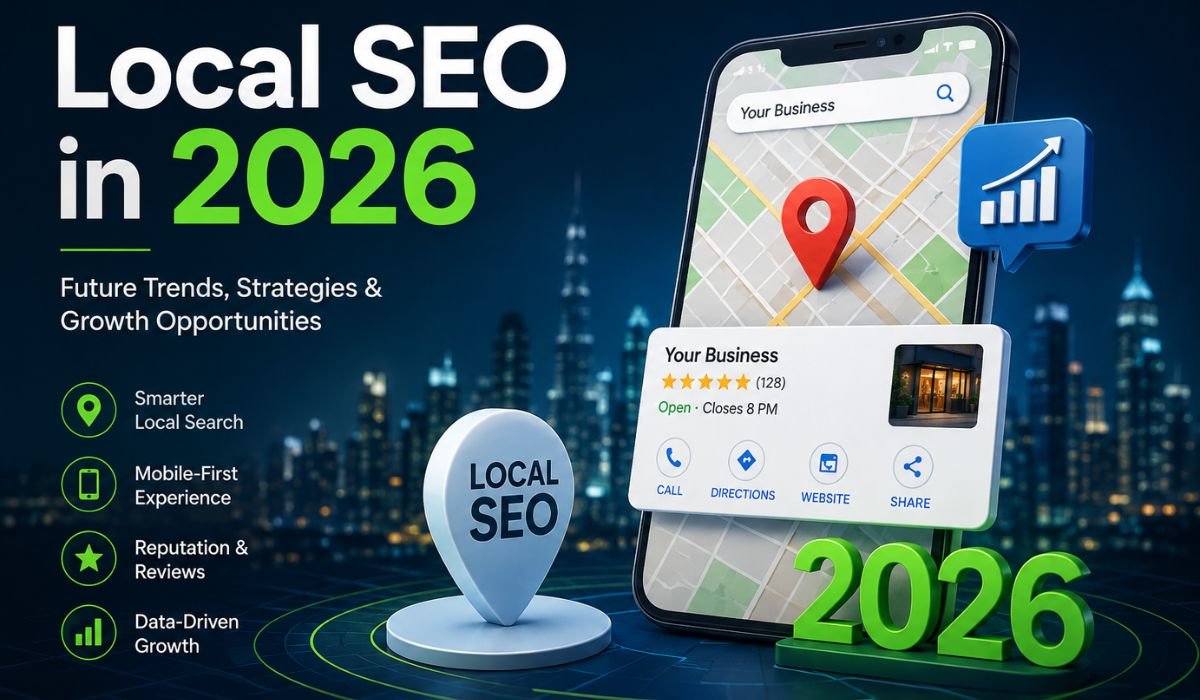
Local SEO in 2026 is changing faster than ever. Businesses can no longer depend only on traditional Google rankings, basic keyword placement, or a few directory listings to attract customers. The way people discover local businesses is becoming more conversational, more visual, and increasingly influenced by artificial intelligence.
Today, a customer may search Google for a nearby service, check Google Maps, read recent reviews, watch a short video, or even ask an AI assistant for a recommendation. This means local businesses need to build visibility across several search experiences rather than focusing on one ranking position.
Google’s AI Overviews are also changing how local information is presented. Recent industry research and tracking show that AI-generated results are increasingly appearing for local and problem-solving searches, creating another layer between businesses and potential customers.
The good news is that the fundamentals of local SEO still matter. A complete Google Business Profile, accurate business information, useful local content, genuine customer reviews, and a trustworthy website remain important. What has changed is how these elements work together.
This guide explains Local SEO in 2026, the major trends businesses should understand, and practical ways to improve local visibility.
What Is Local SEO?
Local SEO is the process of improving a business’s online presence so that it can appear when people search for products or services in a particular geographic area.
For example, someone might search:
- Best restaurant near me
- Plumber in Karachi
- Dentist near my location
- Digital marketing agency in Lahore
- Coffee shop near me
These searches have strong local intent because the person is looking for a business they can potentially visit, call, or contact.
Local SEO focuses on search engines, Google Maps, business directories, reviews, local content, and other online signals that help search engines understand where a business operates and what it offers.
Why Local SEO in 2026 Is More Important
Local customers are becoming increasingly comfortable using search and AI tools to make purchasing decisions. At the same time, search results are becoming more competitive.
A business might have a good website but still struggle to attract local customers if its Google Business Profile is incomplete or its location information is inconsistent across the internet.
The rise of AI has added another challenge. AI-generated search experiences can summarize information and recommend businesses without requiring users to browse through traditional results. Industry analysis in 2026 indicates that AI is becoming an additional discovery channel for local businesses.
This means businesses should think beyond simply asking, “How do I rank number one?”
A better question is:
“How can I become one of the most trusted and relevant businesses that search engines and AI systems can understand and recommend?”
Google Business Profile Remains Essential
Google Business Profile is still one of the most important parts of local SEO.
Your profile should contain accurate and complete information, including:
- Business name
- Address
- Phone number
- Website
- Opening hours
- Business category
- Services
- Photos
- Products where appropriate
- Business description
- Customer reviews
- Questions and answers
An incomplete profile can make it harder for both customers and search engines to understand your business.
In 2026, simply creating a profile and forgetting about it is not enough. Businesses should keep important information updated and continue adding useful content when appropriate.
Reviews Matter More Than Ever
Customer reviews are a major part of local reputation.
When someone searches for a local business, reviews can influence whether they decide to call, visit, or purchase. Reviews can also provide search engines with additional context about a company’s products and services.
The best approach is not to buy fake reviews or ask customers to post identical messages. Instead, encourage genuine customers to share their real experiences.
A good review strategy includes:
- Asking satisfied customers for honest feedback.
- Making the review process easy.
- Responding professionally to positive reviews.
- Addressing negative reviews politely.
- Avoiding fake or incentivized reviews that violate platform guidelines.
Fresh and authentic customer feedback can also help potential customers understand what your business actually does.
AI Search Is Changing Local Discovery
One of the biggest developments in Local SEO in 2026 is the growth of AI-powered search.
Google AI Overviews can summarize information from multiple sources and provide users with direct answers. Other AI platforms can also be used by people looking for recommendations.
This creates a new opportunity for local businesses.
Instead of optimizing only for a traditional keyword such as “best electrician in Karachi,” businesses should create useful content that answers real customer questions.
For example:
- How much does an electrician cost in Karachi?
- What should I check before hiring an electrician?
- How quickly can an electrician respond to an emergency?
- What electrical problems require professional help?
Helpful, specific content gives search systems more information about your expertise and services.
Research published in 2026 also suggests that AI Overview citations can differ from traditional organic rankings, meaning businesses should not assume that ranking well organically automatically guarantees visibility in AI-generated answers.
Create Hyperlocal Content
Generic content is becoming less useful for local businesses.
Instead of writing dozens of pages that repeat the same keyword, create content that genuinely helps people in your service area.
For example, a home repair company could publish:
“Common Plumbing Problems in Older Homes in Karachi”
A restaurant could create:
“A Local Guide to Family Dining in Hyderabad”
A real estate business could publish:
“What First-Time Buyers Should Know About Homes in Lahore”
Hyperlocal content demonstrates knowledge of the community while naturally connecting your business with relevant locations.
The goal should be usefulness rather than keyword stuffing.
Keep NAP Information Consistent
Your business information should be consistent across your website, Google Business Profile, social media pages, directories, and other relevant platforms.
For example, if your business address appears differently on five websites, search engines may have more difficulty determining which information is correct.
Check important directories regularly and correct outdated information.
Consistency is especially important for businesses that have moved, changed phone numbers, rebranded, or opened additional locations.
Build Location Pages the Right Way
Businesses serving multiple cities or areas may need location pages.
However, creating dozens of nearly identical pages with only the city name changed is not a strong strategy.
A useful location page should provide genuinely local information, such as:
- Services available in that area
- Local address or service coverage
- Operating hours
- Customer information
- Relevant local examples
- Photos
- Directions
- Frequently asked questions
- Testimonials when appropriate
Each page should provide a reason for a local customer to visit it.
Optimize for “Near Me” Searches
“Near me” searches remain an important part of local search behavior.
Examples include:
- Restaurants near me
- SEO agency near me
- Car repair near me
- Best dentist near me
- Grocery store near me
You don’t need to repeatedly place the phrase “near me” throughout your website.
Instead, build strong local relevance by clearly communicating your location, services, service areas, and business information.
Google can understand geographic intent without requiring awkward keyword repetition.
Don’t Ignore Your Website
Some businesses focus heavily on Google Maps and forget their website.
That is a mistake.
Your website should clearly explain:
- What you offer
- Where you operate
- Who you serve
- How customers can contact you
- Why customers should choose you
Important service pages should be easy to find and written for humans first.
Your website should also work well on mobile devices because many Local searches happen when people are away from their computers.
Fast loading times, simple navigation, clear contact information, and strong calls to action can improve the overall customer experience.
Use LocalBusiness Schema
Structured data can help search engines understand important information about a business.
For eligible businesses, LocalBusiness structured data can communicate information such as business type, location, opening hours, and other details.
Schema should not be viewed as a magic ranking trick. Instead, it should be used to make your business information easier for search engines to interpret.
Your structured data should accurately represent information that is visible and supported on your website.
Local Links Still Have Value
Links from relevant local websites can strengthen a business’s online presence.
Instead of trying to collect hundreds of low-quality backlinks, focus on genuine relationships and relevant websites.
Potential opportunities include:
- Local newspapers
- Community organizations
- Local business associations
- Industry websites
- Local blogs
- Sponsorship pages
- Relevant partnerships
- Local events
One relevant local mention can be more valuable than a large number of unrelated links.
Photos and Visual Content Are Becoming More Important
Local customers want to see businesses before visiting them.
Restaurants can show food and interiors. Hotels can show rooms. Salons can show their work. Retail stores can show products and the shopping environment.
Use genuine, high-quality images that represent the real business.
Avoid misleading stock images.
Regularly updating your visual presence can also make your profile look more active and trustworthy.
Social Media Supports Local Visibility
Social media is not a replacement for local SEO, but it can support your overall online presence.
Local businesses can use platforms such as Facebook, Instagram, TikTok, and YouTube to publish:
- New products
- Customer experiences
- Behind-the-scenes content
- Local events
- Special announcements
- Educational videos
- Short demonstrations
When people repeatedly encounter a business across different platforms, it can strengthen brand recognition.
Track More Than Rankings
In 2026, ranking position alone does not tell the complete story.
A local business should monitor metrics such as:
- Website traffic
- Phone calls
- Direction requests
- Form submissions
- Google Business Profile interactions
- Search impressions
- Customer reviews
- Conversion rates
- Branded searches
AI-generated results can also change the relationship between visibility and clicks. A business might be mentioned in an answer even when the user does not immediately visit its website.
Therefore, measuring leads and real customer actions is more useful than focusing only on one keyword’s position.
Avoid Common Local SEO Mistakes
Several mistakes can damage a local SEO campaign.
Keyword Stuffing
Repeating the same location and keyword excessively makes content unnatural.
Fake Reviews
Fake reviews can damage trust and potentially violate platform policies.
Duplicate Location Pages
Creating hundreds of pages with almost identical content provides little value.
Incorrect Business Information
Old phone numbers, addresses, or opening hours can frustrate customers.
Ignoring Negative Reviews
Negative feedback should be handled professionally rather than ignored.
Buying Low-Quality Links
Large numbers of irrelevant backlinks do not automatically create authority.
Neglecting Mobile Users
A website that is difficult to use on a phone can lose potential customers.
A Simple Local SEO Strategy for 2026
Businesses that want a practical starting point can follow this sequence:
Step 1: Fully optimize your Google Business Profile.
Step 2: Make sure your name, address, and phone number are consistent online.
Step 3: Build useful service and location pages.
Step 4: Encourage genuine customer reviews.
Step 5: Publish helpful local content.
Step 6: Add relevant structured data.
Step 7: Build relationships with legitimate local websites.
Step 8: Add authentic photos and videos.
Step 9: Monitor calls, leads, traffic, and customer actions.
Step 10: Review your strategy regularly as Google and AI search continue to evolve.
What Does the Future of Local SEO Look Like?
The future of local SEO will probably become increasingly focused on entities, context, reputation, and customer experience.
Search engines and AI systems need to understand not only what a business says about itself but also whether independent information supports those claims.
This makes consistency and trust increasingly important.
The emerging model is not simply:
Keyword → Ranking → Click
It is becoming closer to:
Business information → Relevance → Trust → Recommendation → Customer action
Recent industry discussion describes this evolution as a move toward AI systems evaluating location data, local context, customer intent, and evidence before recommending businesses.
That does not mean traditional SEO is dead. It means local businesses need a broader strategy.
Conclusion
Local SEO in 2026 is about much more than ranking on Google Maps. Businesses need to create a trustworthy digital presence that works across Google Search, Maps, websites, reviews, directories, social platforms, and emerging AI search experiences.
The fundamentals remain straightforward: maintain accurate business information, optimize your Google Business Profile, earn genuine reviews, publish useful local content, improve your website, and build relevant authority.
The biggest change is that customers now have more ways to discover businesses. Some will use Google Maps, some will search Google, and others may ask an AI assistant for a recommendation.
Businesses that focus on genuine usefulness, strong local relevance, accurate information, and customer trust will be in a much stronger position to benefit from these changes.
FAQs
What is Local SEO in 2026?
Local SEO in 2026 is the process of improving a business’s online visibility for location-based searches across Google Search, Google Maps, AI-powered search experiences, business directories, and other digital platforms.
Is Google Business Profile still important in 2026?
Yes. Google Business Profile remains an important part of local visibility. Businesses should keep their profiles accurate, complete, and up to date with relevant services, hours, photos, and customer information.
How can I improve my local SEO?
Start by optimizing your Google Business Profile, maintaining consistent business information, collecting genuine reviews, creating useful local content, improving your website, earning relevant local links, and tracking customer actions.
Does AI affect Local SEO in 2026?
Yes. AI-generated search results are changing how people discover and evaluate businesses. Local businesses should create clear, useful, trustworthy information that search engines and AI systems can understand and reference.
How long does Local SEO take to work?
There is no fixed timeline. Results depend on competition, location, website quality, business reputation, existing authority, and the work being performed. Some improvements may appear relatively quickly, while building strong local authority can take months.
Read More About : Fluxenia
